Which software is best for Scope 3?
Are you searching for “best carbon accounting software for scope 3 emissions”? The short answer is that the right choice depends on the data you have, what your value chain looks like and how the climate calculations will be used. A relevant comparison therefore starts with your workflows, not a generic ranking.
Prioritize software that can collect relevant source data, combine activity data with spend data and make the assumptions behind the calculations understandable. Also explore how the results can be used by sustainability managers, buyers and people working in sales and tenders.
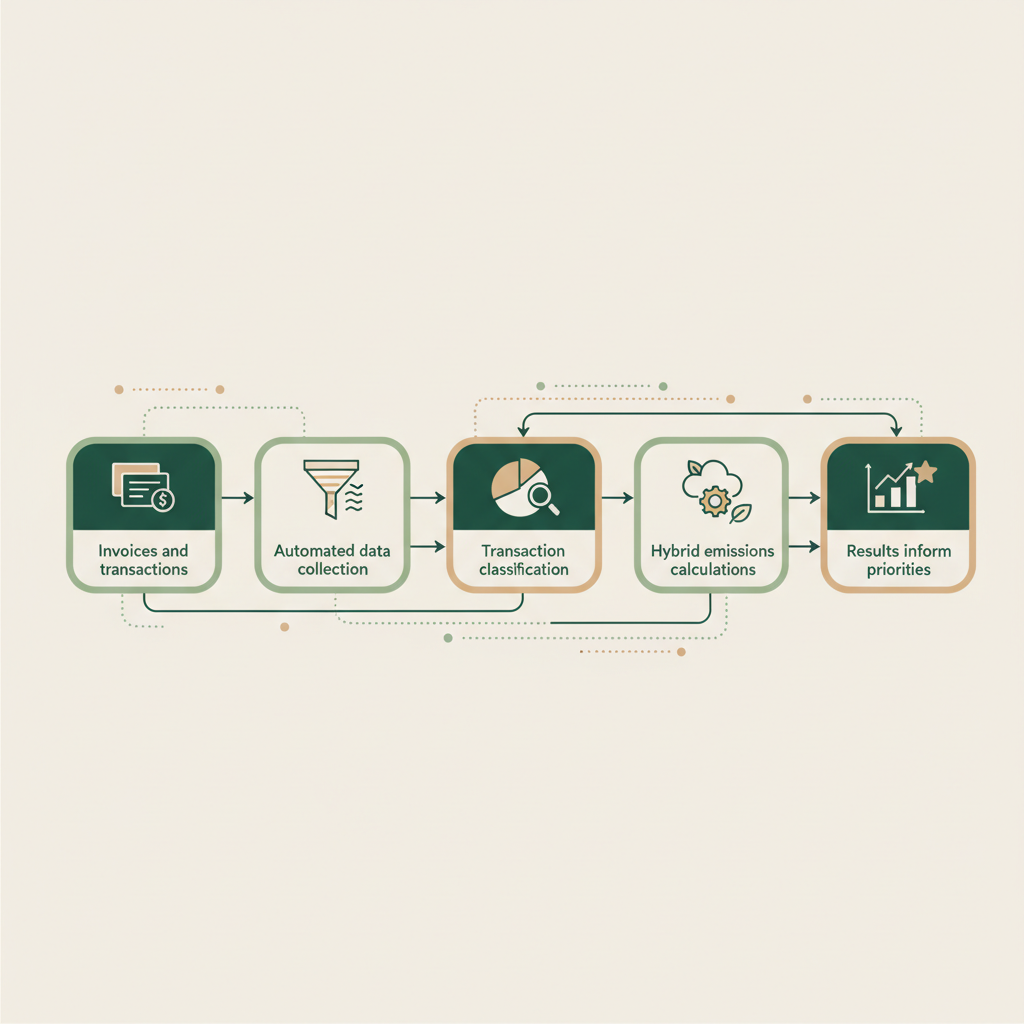
CO2check is an option to evaluate when you need automated data collection, automated and verified transaction classification and a hybrid method that prioritizes activity data alongside spend data. Here, we go through what you should check before choosing.
Why does Scope 3 place specific demands on software?
Scope 3 covers indirect emissions in the value chain beyond your own operations’ direct emissions and purchased energy. Source data may be found in areas such as purchasing, transport, business travel and the use of sold products. Which categories are relevant depends on the business.
The challenge is that the information is scattered. Your accounting system shows what you have purchased, but not always the material, quantity or mode of transport. Suppliers may have more specific information, but it may be based on different boundaries and calculation methods.
The software therefore needs to help you manage both available information and data gaps. A clear presentation is not enough if you cannot understand what the results are based on.
Start with data collection
Map out where your source data is located before booking demonstrations. Distinguish between information that can be retrieved regularly and information that requires manual collection or contact with suppliers.
Ask each provider to show how the software handles:
- Invoices and transactions from accounting systems or ERP.
- Information on travel, transport and other activities.
- Supplier data with varying levels of detail.
- Missing information, duplicates and changes in source data.
- Updates when new data becomes available.
CO2check offers automated collection of data from invoices, ERP, energy, travel and suppliers. During a walkthrough, check which connections and workflows fit your systems. A platform offering automation does not mean that every data source works without preparation.
Choose a method based on data quality
Spend-based calculations use monetary purchasing values and emission factors. They can provide an initial basis when information such as weight, quantity or transport distance is missing. At the same time, results are affected by how purchases are classified and which factors are used.
Activity-based calculations use physical activities, such as fuel consumption or the quantity transported. They can provide a basis more closely aligned with your operations when activity data and emission factors are relevant to what is being calculated.
A hybrid method combines these approaches. You can start with available transaction data and improve selected areas when more specific information becomes available. Check how the software avoids double counting when spend-based source data is replaced with activity data.
CO2check uses automated transaction classification and a hybrid method with both activity data and spend data. The methodology draws on 20+ databases. Ask for a walkthrough of how this is applied to your purchasing categories and data sources.
Examine AI, traceability and assumptions
AI classification can make it easier to sort transactions, but should not be treated as a guarantee of correct results. Unclear invoice descriptions and mixed purchases may require business-specific knowledge.
Ask how you can review classifications, correct errors and understand which items need additional checks. Also ask the provider to explain how changes affect previous calculations.
For each priority emissions area, you should be able to assess the relationship between source data, category, emission factor and result. Therefore, explore whether the solution makes it possible to trace:
- Which data source the calculation is based on.
- Which boundaries and assumptions are used.
- Which emission factor has been selected and why.
- Where estimates replace more specific information.
These are evaluation criteria, not confirmation that every feature is available in CO2check or any other individual solution.
Assess the value for sustainability, purchasing and tenders
For sustainability managers, the results need to provide a basis for setting priorities, improving data quality and monitoring progress. If you work with reduction targets, you should also distinguish between the emissions calculation itself and the process of setting targets. CO2check uses SBTi for reduction targets.
For purchasing, the question is which suppliers and purchasing categories should be examined more closely. Spend-based results can help you choose where to start, but on their own they are not a reliable basis for comparing equivalent products from different suppliers. That requires comparable boundaries and more specific data.
For sales and tenders, it is important to be able to explain what the calculations cover. Check that the source data addresses the customer’s specific question. A calculation for the entire company is not automatically a calculation for an individual product or delivery. Read more about this use case at win tenders.
Compare the options using the same test data
Ask providers to work with a representative sample of your own data. Include both straightforward and hard-to-interpret transactions, available activity data and examples where information is missing.
Then assess the same questions for each option: What requires manual handling? How is the classification explained? What happens when better supplier data becomes available? How clearly are uncertainties and boundaries presented?
Also request a clear description of implementation, division of responsibilities, support and costs. Evaluate the internal workload alongside the software, not as a separate afterthought.
When is CO2check relevant to evaluate?
CO2check is relevant to explore if you want to automate the collection of scattered source data and combine transaction-based calculations with activity data. The platform’s areas include sustainability, sales and tenders, and purchasing.
The next step is to compare your specific needs with how the solution works. Read more about software for Scope 3 and climate calculations. Choose the solution that makes your climate calculations useful and understandable, and gives you a clear path to better data.